
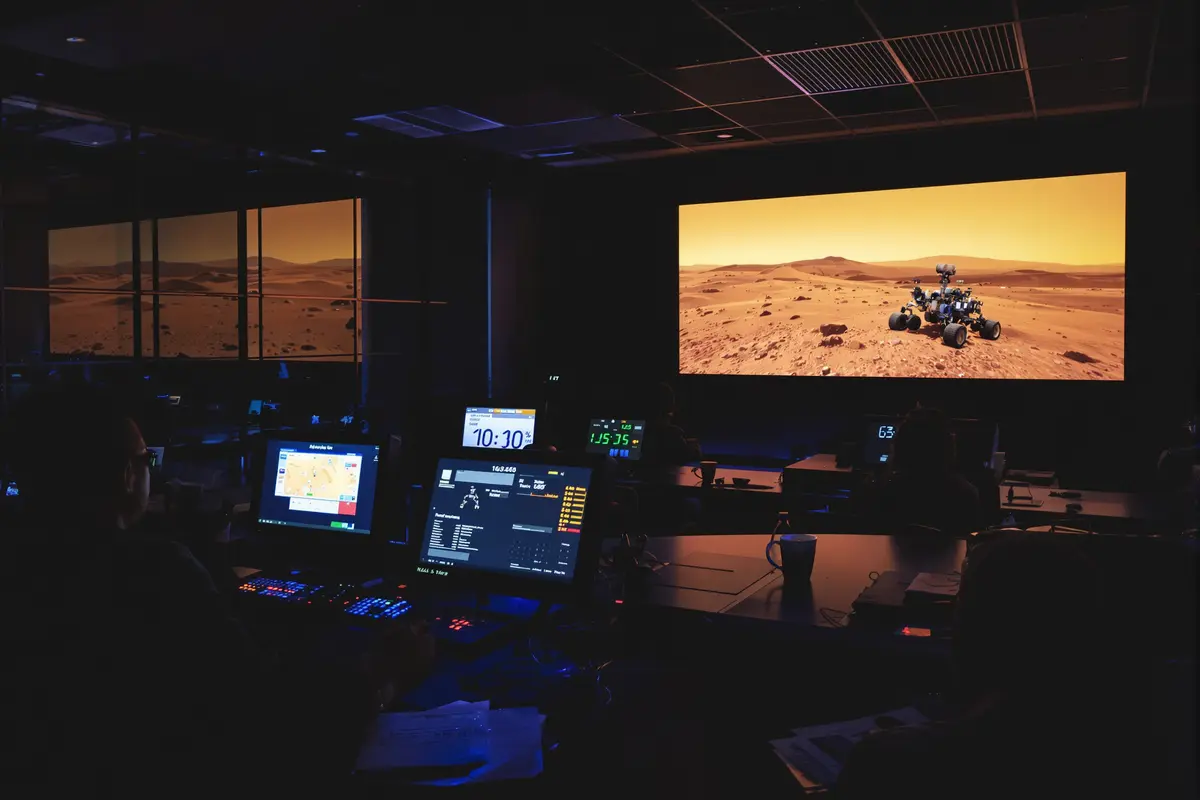
What if your day lasted nearly 40 minutes longer than everyone else’s? On Mars, that “extra time” isn’t just a quirk — it’s a full-blown reality. And now, it’s forcing NASA and other space agencies to rethink everything from engineering to human sleep. It turns out: Einstein was right — and his theories aren’t just chalkboard concepts anymore. They’re changing how we explore the Red Planet.
Time Flows Differently on Mars — Literally
A day on Mars isn’t 24 hours like on Earth. It’s 24 hours, 39 minutes, and 35 seconds. That might sound small on paper, but for mission teams, it’s a daily shift that adds up fast.
NASA engineers call it “living on Mars time.” When a rover like Perseverance starts its day, Earth-based operators do the same — even if that means waking up at midnight and eating lunch in the dark. Every day, their clocks slide 39 minutes out of sync with Earth.
After one week, they’re nearly 5 hours off. After a few weeks, their whole schedule feels upside down. It’s more than just “planet jet lag.” It’s a lifestyle overhaul.
Einstein’s Theory in Action
Albert Einstein predicted that gravity and speed affect time. The stronger the gravity or the faster you move, the slower time ticks. That’s general relativity.
Since Mars has weaker gravity and it moves at a different speed around the Sun compared to Earth, clocks there tick just a bit faster than on Earth. For Mars missions, that’s not just theoretical — it’s measurable.
Over time, these tiny differences can create big problems. Spacecraft could land meters — even kilometers — off their target if time drift isn’t corrected. That’s the kind of error that turns a smooth landing into a deadly crash.
Why This Time Difference Matters So Much
For short missions, engineers can manage with careful adjustments. But as we plan for long stays on Mars, the clock becomes a serious challenge.
- Scheduling science operations: Rovers must wake and work during Martian daytime to avoid bitter cold at night.
- Synchronizing spacecraft: Orbiters, landers, and Earth all need matching timestamps for smooth communication.
- Future astronaut needs: From sleep cycles to talking with family back home, mismatched time creates stress.
Without fixing these gaps, missions risk everything from missed rendezvous to broken equipment coordination.
Creating a Shared “Mars Time”
To stay in sync, space agencies are now working on a universal Mars time standard — Mars’ own version of Earth’s Coordinated Universal Time (UTC).
This means setting a shared second, a shared noon, and even a shared Martian calendar. It sounds odd, but it’s crucial. Different countries’ robots and human crews will need a common clock to cooperate safely.
Engineers are testing software that auto-converts times between Earth and Mars, with Einstein’s equations baked in to correct for relativity. It’s no longer “nice to have” — it’s mission-critical.
Helping Humans Adjust to the 24h39m Sol
Right now, astronauts train to “live between two clocks”. They test light systems that simulate slow Martian dawns using soft red and blue light. They shift meal times, build nap routines, and take scheduled sleep aids to keep their minds sharp.
Long-term exposure to Mars’ day length could mess with our bodies. Your circadian rhythm—the body’s internal clock—is tuned to Earth’s gravity and light. On Mars, being out of sync can lead to sleep disorders, mood swings, slower reflexes, and mental fatigue.
That’s why future Mars missions will include strict “time hygiene” practices:
- Consistent wake times
- Timed meals and naps
- LED lighting tweaked to Martian sunlight
- Medical tools to monitor alertness
Some teams even suggest a “hybrid time”: Earth time inside the habitat, Mars time outside during surface operations. But juggling two clocks might come with its own mental toll.
The Long View: Living With Two Futures
This split in time isn’t just a mission challenge. It hints at something deeper. As humans stretch into space, our very concept of time may break apart.
Imagine kids born on Mars. Their birthdays will always last 39 minutes longer. Their calendars will be based on sols, not days. Time zones may one day be anchored to craters and canyons, not continents.
Even a phone call between Paris and a Martian dome in Jezero Crater could feel subtly off — like one person is always just a little bit behind the other. Both would be right. Yet still out of sync.
As one European mission planner put it, “Time is no longer the background — it’s the environment.”
FAQ: Your Mars Time Questions Answered
Does time really pass at a different rate on Mars?
Yes, but very slightly. Because Mars has weaker gravity and moves differently, clocks tick just a bit faster than on Earth — just like Einstein said.
Is that the same as the longer day?
No. The 24h39m sol comes from how slow Mars spins. Relativity is a separate effect that adds a micro-difference in how time flows.
Will astronauts feel this time difference?
They’ll feel the longer day in their schedule and sleep patterns. The relativity effect is too small to feel, but it shows up in critical math and software.
How do current missions handle Mars time?
Rovers follow local Martian time. NASA teams sync with their daylight, often shifting their own routines to keep up.
Will future Mars settlers use a new calendar?
Probably. Researchers are experimenting with Martian calendars, sols, and local time zones — but Earth time will still matter for calls and coordination.
Conclusion: Time Has Become a Mission Variable
As missions on Mars grow longer and more complex, time is no longer fixed. It bends, it drifts, and it matters in ways we’re only just learning to manage. From signal delays to sleep disorders, Mars is teaching us what it means to build a life in a place where even the seconds don’t agree.
Einstein imagined time as flexible. For the men and women exploring Mars, it’s become a problem to solve, a clock to reset, and a future to live inside.