
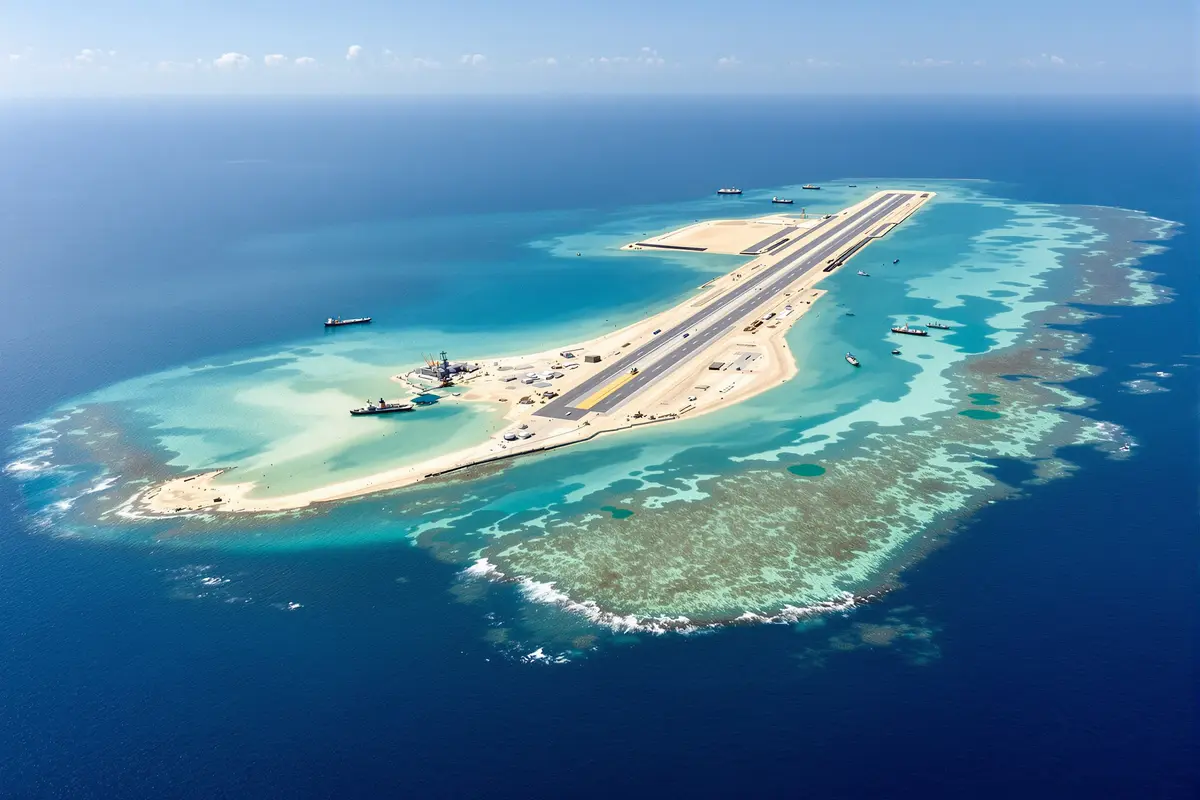
What if the ocean wasn’t the end of the story—but the beginning of something entirely new? For over a decade, China has been doing something that almost sounds like science fiction: dumping sand into the sea to raise entire islands from nothing. What’s risen from the South China Sea isn’t just land—it’s a bold, disruptive, and controversial move that’s changing the way the world looks at coastlines, power, and territory.
From open water to concrete islands
In the heart of the South China Sea, what used to be little more than submerged coral reefs are now hubs of strategic infrastructure. Where the waves once ruled, you’ll now find airstrips stretching 3 kilometers long, radar domes, missile platforms, and harbor facilities. This transformation all begins with sand.
Between 2013 and 2016, China built more than 1,200 hectares of new land in the Spratly Islands. That’s about the size of 1,600 football fields, carved not from rock but from dredged-up seabed. Massive dredgers sucked sand from the ocean floor and blasted it onto vulnerable reefs, creating flat land and holding it in place with concrete and rock.
The idea behind the islands
Why go through this enormous effort? At the core is a single strategic idea: if you want to extend your influence far from your coastline, you need solid ground out at sea. These artificial islands do exactly that.
By creating permanent land structures, China transforms vague territorial claims into visible, usable assets. The installations officially serve “civilian” purposes—search and rescue hubs, weather stations—but their true use is often military. On satellite images, you can clearly see anti-aircraft systems, hardened hangars, and long-range sensors.
Impact on the region and the world
This part of the ocean might seem far away, but it’s incredibly important. About one-third of global shipping passes through the South China Sea. Beneath its surface lie massive reserves of oil and gas. For countries like the Philippines, Vietnam, and Malaysia, this sea is crucial—it’s about food, fuel, and sovereignty.
But now, Chinese-built islands sit like solid chess pieces in a shifting game. These new platforms allow coast guards and naval vessels to monitor and intercept foreign ships. It’s a way of saying: “This is our water now.” That message doesn’t sit well with China’s neighbors—or with countries like the United States that support a free and open Indo-Pacific region.
The environmental toll
What lies beneath tells a quieter, darker story. To build these artificial islands, dredging ships ripped through coral reefs, stirring up sediment that smothers marine life. Fish can no longer spawn. Turtles lose their feeding grounds. Entire reef ecosystems have been buried or bleached out of existence.
This has a direct impact on coastal communities. Fishermen who relied on these waters for generations now face empty nets or are chased away by patrol boats. Some have had to quit entirely, unable to keep up with the costs or risks.
Can these islands last?
These islands might look strong, but they fight a never-ending battle with the sea. Waves, storms and erosion constantly threaten to eat away at their foundations. Every meter of structure has to be maintained—at great cost. What’s more, as sea levels rise due to climate change, even man-made land isn’t immune.
Behind the concrete is a fragile system: workers who live in isolation, worn-down equipment, and the relentless force of nature. These islands stand now, but not without constant effort.
The legal and diplomatic battle
Internationally, these islands are controversial. In 2016, a tribunal in The Hague ruled that many of China’s claims in the South China Sea are invalid under international law. China ignores this ruling and continues to build and operate as if the sea is theirs alone.
Other countries have made smaller attempts at island building, but no one has matched China’s scale or speed. And each new radar dome or pier isn’t just concrete—it’s a signal, a move in a long and dangerous geopolitical game.
Why does this matter to you?
Maybe you live far from the South China Sea. But chances are, products in your home—your phone, your clothes, your food—made part of their journey through these contested waters. If tension in the region rises, it could disrupt global trade, raise shipping costs and spark international conflict.
These islands reshape not only the ocean floor but also international politics, economic routes, and environmental futures. They’re becoming permanent landmarks in a region that was once fluid and open.
Looking at a new kind of coastline
This story isn’t just about China or the South China Sea. It’s about how technology makes it possible to manufacture land and change borders without changing maps. It’s about how one country’s search for power and security can ripple across oceans and affect lives worldwide.
So next time you hear about artificial islands or glance at a globe, remember: beneath the calm blue surface of the sea, entire new landscapes have quietly taken root—shifting more than just sand. They’re shifting our sense of what’s possible, and what’s at stake.