
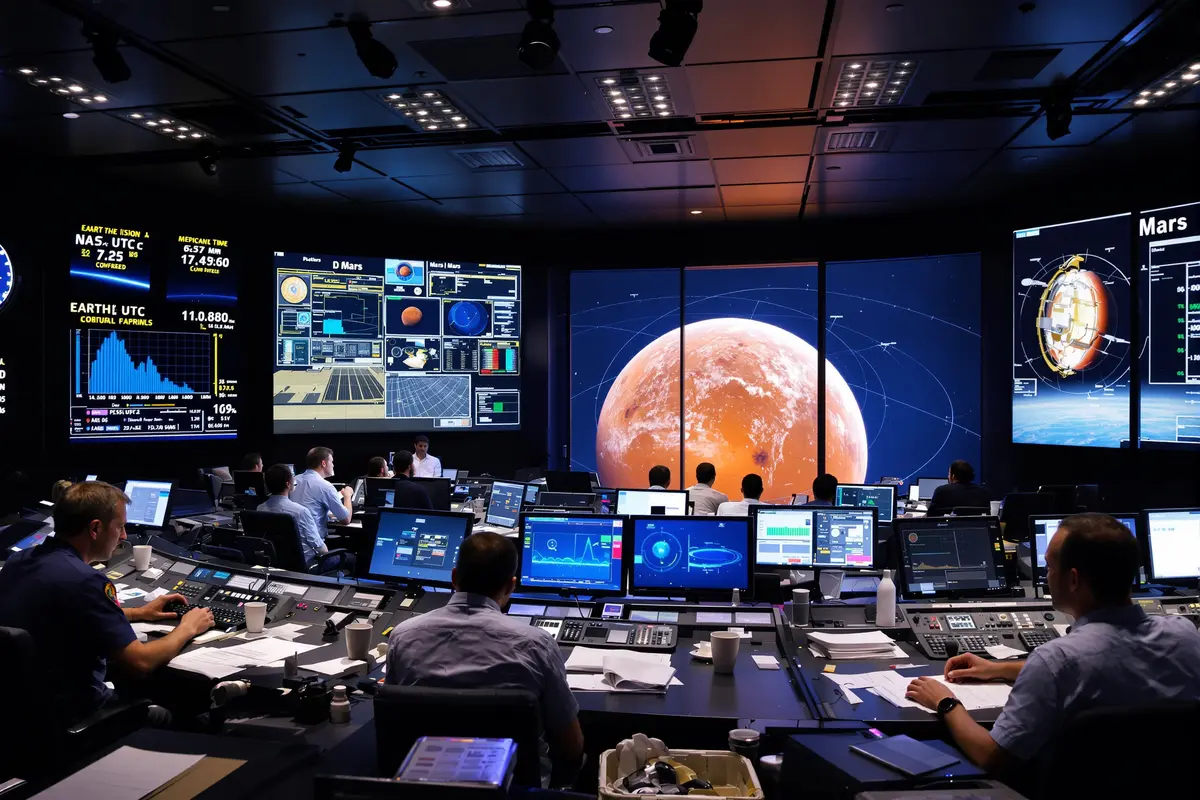
When you think of Mars, you probably picture red rocks, dusty robots, and distant science fiction dreams. But what if one of the biggest challenges of Mars isn’t rockets or oxygen… it’s time? Believe it or not, time doesn’t tick the same on Mars. And that odd fact is forcing space missions—and even people—to rethink everything from clocks to sleep habits.
Time on Mars runs differently—Einstein knew it all along
More than a century ago, Albert Einstein changed the way we think about time. His theory of relativity showed time isn’t fixed. It bends and shifts depending on gravity and speed. That sounded abstract—until we starting landing rovers on Mars.
A day on Mars, called a sol, lasts 24 hours, 39 minutes, and 35 seconds. Just a little longer than Earth’s 24-hour day. At first glance, that seems too small to matter. But over days and weeks, that 39-minute difference turns everything upside down.
Mars missions already live on “Martian time”
When NASA operated missions like Curiosity and Perseverance, engineers on Earth had to adjust. Shift by shift, they started work almost an hour later each day. One week they showed up at 9 a.m. Next week? Maybe 4 a.m.
Helpless to match Mars’ slow tilt, teams posted signs saying “Living on Mars time.” Coffee cups sat beside jet-lag pills. Families had to tiptoe through daytime naps. The mission wasn’t just high-tech—it was a full-scale social experiment in time distortion.
Why clocks tick faster on Mars—at least slightly
Here’s where Einstein gets the last word. Mars has about 38% of Earth’s gravity. That lower gravity means clocks tick a little faster than they do here. The difference is tiny—you won’t feel it in your bones—but it matters a lot in deep-space missions.
Add in the fact that Mars moves around the Sun at a different speed, and now even satellites and landers on Mars tick differently. Every robot, every base, will need its own version of “now.” Relativity isn’t just a concept anymore—it’s mission-critical.
Why we need a whole new way to measure time
For decades, the space world used Earth’s clock—UTC (Coordinated Universal Time)—as its standard. But Mars isn’t Earth. Now, scientists are developing “Mars Coordinated Time” (MTC) that’s based on Mars itself, not radio signals from Earth.
Rovers already divide sols into special “Mars seconds” so they match the longer Martian day. In the future, astronauts may wear watches that switch between Earth and Mars time, just like smartphones adjust when you change countries—only this time, you’re changing planets.
What all this means for future space settlers
Let’s say you move to Mars in the 2040s. At first, your Earth-trained body will feel out of sync. Jet lag from stretching your day every 24.6 hours. Sleep scientists worry about fatigue, headaches, and mood swings. Can your brain reset its rhythm?
Some early studies say humans can adapt. Others warn of trouble. Kids growing up on Mars might find a 24.6-hour cycle totally natural—and visiting Earth could feel like waking up too early every single day. That famous 9-to-5 job may not survive space travel at all.
Communication delays create strange versions of “now”
When you send a message to Mars, it can take up to 22 minutes to arrive. That’s more than just slow texting. It means Earth and Mars are always slightly out of sync. So how do you define “now” when every planet uses its own clock?
Space teams are starting to change the way they plan. Instead of assuming one master time, they’re working with:
- Local clocks on each planet or moon, based on its own spin and gravity
- Autonomous onboard systems that don’t need Earth to correct them
- Mission plans that expect delay and don’t treat it as failure
- Displays showing multiple time zones—even if they’re on different worlds
The goal is to stop pretending time is absolute. Just like you wear different clothes in each climate, you’ll wear different time systems in different worlds.
One day, Mars time will feel completely normal
Here’s the wild part: after a while, all of this could feel… ordinary. Settlers may wake up with the first soft light of a Mars morning. Work shifts will slowly rotate, matching sol by sol. Sleep schedules, school bells, even sports games will live by that 24.6-hour rhythm.
Earth will feel like the time zone that’s off. On Mars, our rules about clocks—set centuries ago—will fade. Each planet will follow its own tick. Our calendars, our “working hours,” even holidays may shift with the dust storms and seasons of another world.
FAQs: How Mars warps time and why it matters
Is time really faster or slower on Mars?
Yes, in practical ways. Mars has a longer day than Earth, and weaker gravity makes clocks run slightly faster. Combine that with a different orbital speed, and Mars runs on its own version of time.
Would I notice time passing differently on Mars?
You wouldn’t feel it instantly, but you’d notice the sun rising and setting a bit later each “day.” Over time, your sleep, meals, and habits would slowly drift compared to life on Earth.
Why does relativity matter for future space missions?
Because even microsecond errors can throw off landings and navigation. Space systems need timing as accurate as possible. Slight clock shifts from relativity really can affect everything.
Will Mars have its own official time zone?
Experts are exploring a system like Earth’s UTC—called Mars Coordinated Time (MTC)—so that all Mars-based missions can stay in sync with each other.
Could Martian cities just keep Earth time?
They might try, but it would feel unnatural. Over time, locals would probably shift to the local light and temperature patterns. Earth’s time might just become something you switch to when calling home.
In the end, the Universe won’t adjust to us. We’ll have to adjust to it—second by second, planet by planet.