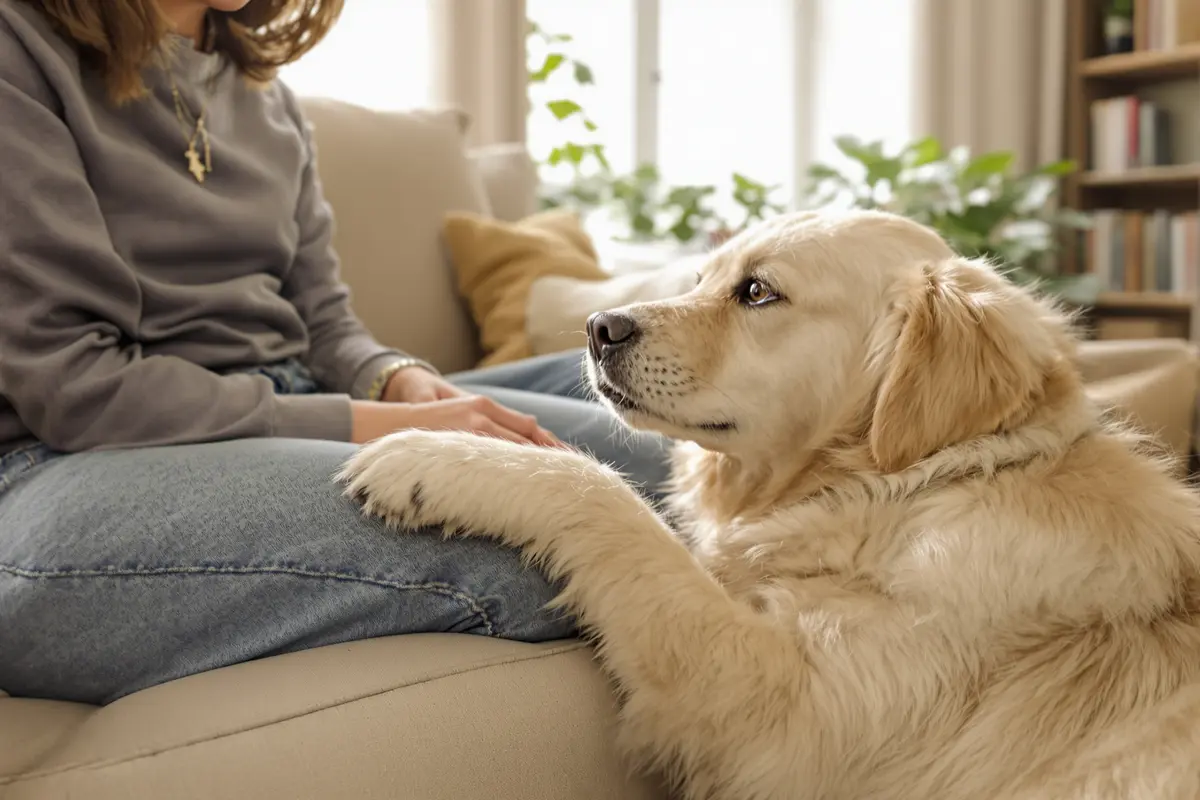
You’re relaxing when you feel your dog’s paw press against your leg. It might seem cute or playful—but experts say it’s often much more than that. From love to stress to a silent request, a paw on your arm carries real meaning. And it’s not always what you think.
The paw is just the beginning of the message
Dogs don’t speak, but they communicate clearly if you know how to listen. That little paw on your leg is only one part of a bigger emotional message. Animal behaviorists agree: dogs never speak with just one body part.
If your dog offers a paw, pay attention to everything else. Look at the ears, tail, posture, and eyes. Is your dog loose and relaxed, or tense and worried? That context tells the full story.
Why dogs reach out with a paw
Dogs use their paws in many ways, and each situation can have a different meaning. Here are some common reasons:
- Seeking attention: Like a child tugging at your sleeve, some dogs use a paw to get your focus.
- Asking for reassurance: If your dog feels nervous or unsettled, a paw can be a quiet way to ask for comfort.
- Trying to communicate stress: Dogs often use calming signals—like yawning, lip licking, and soft pawing—to manage tension.
- Requesting more: If you stop petting and the paw appears, it’s often a gentle reminder: “don’t stop just yet.”
But misreading the gesture happens often. Some owners think it’s always a game. In reality, it could be your dog saying, “I need a break.”
Real story: the dog who was asking for peace
A family thought their Golden Retriever was clingy. Every night, he would place a paw on them again and again. They assumed he wanted playtime. But behaviorists noticed signs of stress: yawning, heavy breathing, low tail.
He wasn’t looking for fun—he was overwhelmed by noise and movement in the house. His paw wasn’t a request to play. It was a quiet cry for help.
How to understand what your dog really means
Experts suggest you pause for three seconds next time your dog lays a paw on you. During that pause, scan their body:
- Are the eyes soft or wide and staring?
- Is the tail wagging gently or stiff?
- Is the body relaxed or tense?
- Is the touch light or digging in?
- What just happened? Was the room noisy? Were tensions high?
By doing this quick check, you’ll get much closer to understanding the real message behind that paw.
What happens if you misread the sign?
Well-meaning owners often reward moments of anxiety without realizing it. Here are two examples:
- Situation 1: The dog barks at the window, then taps your arm. You pet it. The dog learns barking + paw = attention.
- Situation 2: At the vet, your dog presses into your leg with a paw. You’re too focused on speaking to notice. The dog learns that being afraid doesn’t earn comfort.
The solution? Reward calm behavior. Offer gentle presence when your dog appears unsure. And never assume one message fits all situations.
What that paw might really be saying
Once you start paying attention, patterns emerge. Some dogs use their paw during tense moments—like arguments, loud noises, or strangers visiting. Others offer it during calm times, silently asking you not to move, to enjoy the peace together.
Experts recommend respecting that moment. As behaviorist Julie D. says, “When a dog gives you its paw without being asked, it’s a question. Your job is to read it before you answer.”
Turn that gesture into better communication
Here’s a simple way to respond wisely next time:
- For soft, relaxed dogs: Whisper gently, pet slowly on the chest or shoulders.
- For tense, uncertain dogs: Lower your energy. Don’t push closer. Offer soft words and space if needed.
- For overexcited dogs: Stay calm. Wait for the excitement to drop before showing affection.
Quick FAQs
Why does my dog paw at me when I stop petting?
It’s become a polite way to say “please keep going.” If the mood is calm and your dog is relaxed, go ahead and continue.
Is pawing always about wanting something?
Not always. It might express fear, confusion, or just a desire to connect. Context is everything.
Does pawing mean my dog’s trying to dominate me?
No. Modern behavior science has moved past that idea. This is about emotion, not control.
Should I ignore the paw?
Not automatically. If the moment feels calm, welcome it. If it follows pushy or anxious behavior, wait and calm things down before responding.
Can I still teach “shake” as a trick?
Yes! Just keep the training separate from normal life. A trick on command won’t erase what an unsolicited paw might be trying to say.
Final thought: it’s not just a paw—it’s a message
Next time your dog places a paw on you, stop and think. You might be hearing a quiet message that changes how you see your companion. Sometimes it’s “I love you.” Sometimes it’s “I’m not okay.” Learn to read the difference—and you’ll build an even deeper bond.