
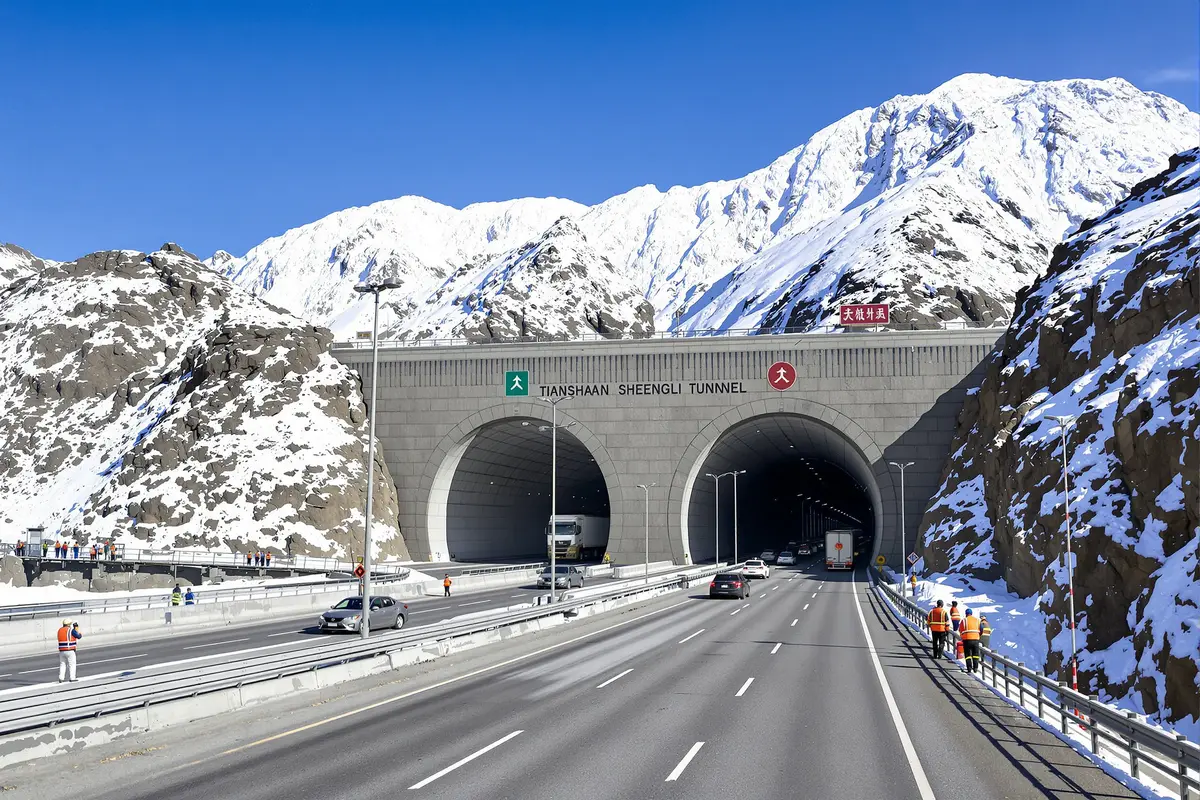
China has just made history — and it did it underground. Hidden beneath the snow-capped Tian Shan mountains lies a marvel of modern engineering: the world’s longest operational highway tunnel, stretching an incredible 22.13 kilometers. Built through one of Asia’s toughest landscapes, this mega-tunnel doesn’t just break records. It transforms how people live, travel, and trade across a once-isolated region.
A shortcut through a mountain beast
Until recently, crossing the mighty Tian Shan meant long, slow drives on narrow mountain roads. Drivers had to brave snowstorms, landslides, and steep climbs — not ideal, especially for trucks or emergency vehicles. Today, that journey takes just 20 minutes, thanks to the new Tianshan Shengli Tunnel.
This underground route links the northern and southern parts of Xinjiang along the Ürümqi–Yuli expressway. Before the tunnel, this route was risky and inefficient. Now, it’s fast, safe, and direct.
Inside the tunnel: A hi-tech backbone
The tunnel has a smart design with two separate tubes, each with two lanes for traffic. Safety is a top priority:
- Emergency exits and escape passages connect the tubes
- A digital control room monitors everything 24/7
- Sensors check air quality, smoke, traffic flow, and rock movement
- A strong ventilation system removes exhaust and keeps air fresh
If there’s a fire or accident, operators can quickly adjust airflow, evacuate parts of the tunnel, and help firefighters navigate the zero-visibility space. Unlike older tunnels in Europe or Japan, this system is built from the ground up with digital tools at its heart.
Built where few dared drill
The Tian Shan mountains aren’t just tall — they’re dangerous. The ground is cold, unstable, and full of surprises like hard ice known as permafrost. Groundwater flows in unexpected ways, and tectonic pressures shift the rocks without warning.
To handle this, Chinese engineers used cutting-edge tools:
- Tunnel boring machines that slice through rock with high precision
- Robots to drill parts of the tunnel
- Smart lighting that adjusts to traffic levels
- Machine learning models to predict rock movement
Instead of brute force, they relied on real-time data and constant monitoring. Every stretch of the tunnel was built with sensors watching how the mountain reacted, minute by minute.
From isolation to connection
For decades, Xinjiang was a remote frontier, far from China’s main economic zones. Harsh landscapes and poor infrastructure made travel long and difficult. But this tunnel changes that story.
Now, fruit trucks, ambulances, and school buses can travel across the mountains quickly and safely. Commuting times are slashed. Jobs, hospitals, and universities are more accessible than ever. A simple tunnel shift reshapes how people plan their lives.
A new route in China’s bigger plans
This isn’t just a project for Xinjiang — it plays into a much larger strategy. The tunnel is part of the Belt and Road Initiative, China’s global trade plan. Together with rail lines that pass through the region, this road link strengthens China’s shipping routes to Central Asia and Europe.
For businesses, a reliable mountain tunnel means more predictable delivery times. And for the government, it supports national unity and improves regional growth.
But what about the planet?
Large infrastructure like this always raises concerns. Environmentalists worry about long-term effects on:
- Groundwater and natural springs
- Animal migration routes
- Mountain ecosystems and rare plants
On the flip side, Chinese officials argue that putting traffic underground cuts down on road accidents in the mountains and reduces emissions from steep mountain climbs. The true impact will become clearer with time — and audits.
What it feels like to drive it
Spending 20 minutes surrounded by rock can feel intense. Engineers focused on making the drive more comfortable with:
- Colored signs and patterns to help drivers keep track of distance
- Different light levels to avoid tunnel fatigue
- Clear messaging about exits and emergencies
Rules will also tighten for freight drivers — no speeding, limits on hazardous goods, and spacing between vehicles. Safety always comes first in an enclosed space like this.
Is this the beginning of a new tunnel era?
Definitely. China sees this as a test run for similar projects in Turkey, Iran, and Pakistan — countries with tough terrains and growing transport needs. The techniques used here, from digital sensors to predictive tools, could become the new norm for tunnel construction worldwide.
But success isn’t just about digging through rock. It’s about long-term upkeep. Without solid maintenance, extreme temperatures and wear over time could turn this marvel into a money pit. Only time will tell.
How it stacks up worldwide
| Tunnel | Country | Length (km) | Type | Opening |
|---|---|---|---|---|
| Tianshan Shengli | China | 22.13 | Highway (2×2 lanes) | 2025 |
| Rogfast | Norway | 26.7 | Highway (2×2 lanes) | 2033 (planned) |
| Ryfylke | Norway | 14.4 | Highway | 2019 |
| Gotthard Road Tunnel | Switzerland | 16.9 | Highway | 1980 |
| Arlberg Road Tunnel | Austria | 13.9 | Highway | 1978 |
The bottom line
China’s Tianshan Shengli Tunnel is more than a record-breaker. It’s a symbol of ambition, technology, and strategy blending into one deep tunnel—and a bold step into the mountains of tomorrow. For people in Xinjiang, it means shorter trips and new chances. For the world, it’s a sign that the future of transportation is being dug, one mountain at a time.